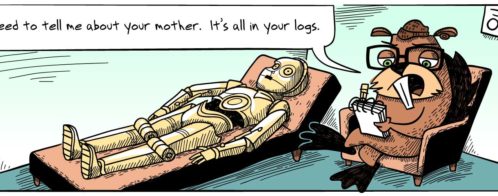


The Human-Centric Stack: Why Logs Are the Great Equalizer in the Age of AI
In 2026, we are seeing incredible feats of engineering with agentic AI, impacting metrics and distributed traces that map thousands of microservices. Our systems have never been more intelligent and complex.
However, as our observability becomes more intelligent, fewer employees know how to manage and troubleshoot complex systems. These employees, who often bear the brunt of an error’s impact, may need to rely on specialists to interpret the system.
As complexity increases, there is a continued need for a text-based log solution that allows people to sit in the driver’s seat and bridge the gap between the problem, the code, and the people who are directly impacted. Text-based logs are a signal telling the story so that, as a developer or site reliability engineer (SRE), you can explore the path a request took to get to the root of an error.
The Expertise Bottleneck
Shouldn’t we keep part of our stack human-centric? When an issue arises, troubleshooting breaks down if complexity creates barriers preventing team members from exploring the code behind the problem.
The people closest to the issue should be able to review logs to troubleshoot problems. Support leads, product managers, or junior developers risk being frozen during an incident if they can’t explore log lines to find an answer to a customer’s timely question. They may have a customer’s question in one hand but no way to explore the code behind the issue in the other. When we hide the truth behind layers of architectural complexity, we disempower the people tasked with helping our customers.
Logs as a Source of Truth
Text-based logs are more than data; they are the story of your application. While a trace shows you the path a request took, a log tells you the rationale of the system at the moment of failure.
When an AI-driven system designed for self-healing fails to fix a production issue, a human has to step in. In those high-pressure moments, we don’t need a multidimensional graph. We need a chronological, text-based narrative of what happened. Using an intuitive, searchable approach to logging allows us to bypass the complexity of modern observability and find the truth.
The power of a logging tool such as SolarWinds® Loggly® lies not only in its ability to ingest data but also in its readability, which enables a searchable log solution to support the following operations:
- Support teams can find the answer to a high-priority ticket in seconds by searching a simple transaction ID, without escalating to engineering
- Product managers can view the real-time use (or misuse) of a new feature to make data-driven pivots
- Developers can debug directly, moving from “problem” to “fix” without wading through unnecessary layers of architectural complexity
Let’s explore a hypothetical use case. It’s a high-traffic Monday. A customer contacts your support team claiming their order disappeared at checkout.
- Scenario 1: [P.1] The support lead opens a ticket, and a developer eventually looks at an application performance monitoring dashboard and sees a 2% spike in 500 errors; an SRE traces the request through three microservices but can’t see why the database rejected the specific write—hours pass while specialists translate the signals
- Scenario 2: The support lead immediately enters the customer ID into the Loggly search bar, and within seconds, they see this log line: “ERROR: Database write failed for User_123 – Reason: Invalid_Coupon_Format”
In the second scenario, the support lead can explain the coupon error to the customer right away. The team can then work on making sure there is a one-line fix. The rationale of the log data gives context and allows the team to address the issue without waiting for an expert to translate what happened.
Simplicity as a Strategy
As we move further into 2026, the goal of observability shouldn’t be to build the most complex system possible; it should be to provide the shortest path to the truth. By making logs human-centric, we give the power of answering back to the people who are holding the support ticket.
When an AI-driven system designed for self-healing fails to resolve a production issue, humans need to step in. These high-pressure moments require a chronological, text-based account of what happened. Using a logging tool with an intuitive, searchable approach provides a practical way to find the answer to solve a support ticket, view real-time misuse of a feature, and debug directly, without unnecessary layers of complexity.
The Loggly and SolarWinds trademarks, service marks, and logos are the exclusive property of SolarWinds Worldwide, LLC or its affiliates. All other trademarks are the property of their respective owners.

Rachel Revoy